


The search for a new board member often begins with a vacancy. The departing member is to be replaced, a well-known personality is proposed, or a single area of expertise is considered obviously missing. This leads to talking about people too early. A robust board search profile begins with the question of what additional contribution the board must make in the next phase of the company.
The board acts as a body. A profile therefore cannot be derived in isolation from a résumé, a job title or the previous mandate. What matters is which expertise is missing on the board as a whole, how the new member complements the existing composition, and which behavior is required for effective collaboration.
Short answer: A good board search profile does not describe the most prestigious person, but the concrete gap on the board. It combines future state, board mandate and skills matrix with verifiable experience, personal contribution, independence, availability and fit with the dynamics of the board.
1. A Vacancy Is Not Yet a Search Profile
A vacant seat provides the occasion and timeframe for the search, but not yet a sufficient definition of the task. Before formulating the profile, the board should distinguish three possible starting points.
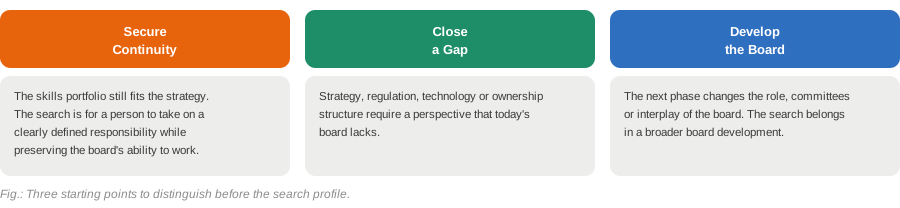
This distinction prevents the predecessor's profile from being automatically carried forward. It also shows whether a new member actually needs to be found, or whether mandates, committee work and responsibilities on the existing board should be reorganized.
2. From Future State to Skills Gap
The future state describes which business situations the board will have to assess and guide over the coming three to five years. From this, titles are not derived immediately, but concrete contributions to board work.
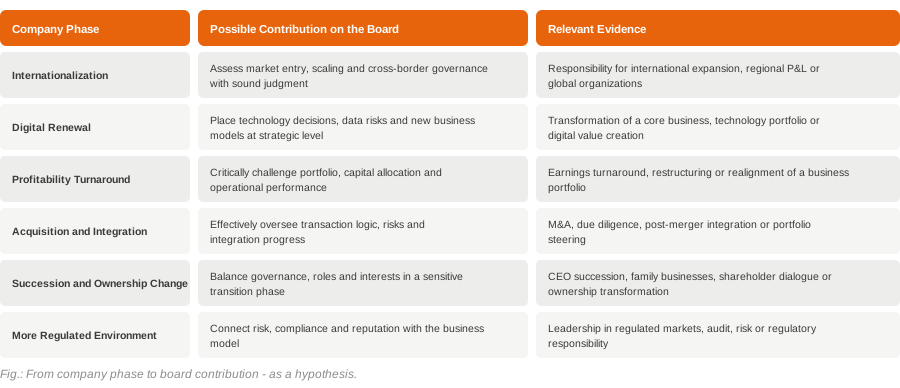
The overview serves as a hypothesis. The same company phase can call for a different profile depending on industry, maturity and existing board expertise. What matters is the additional contribution the new member is meant to make on the specific board.
3. How to Analyse the Board’s Competence Portfolio Effectively
A structured competence portfolio provides transparency about the capabilities already represented on the Board and those required for the company’s next phase. It should not be treated as a collection of general keywords. Terms such as strategy, digitalisation or finance are too broad to form the basis of a robust search profile. Each competence must therefore be linked to a specific Board responsibility and the required level of expertise.
— Future Before Status Quo
The competence portfolio should be developed from the company’s future direction and only then compared with the current composition of the Board. Starting with the CVs of existing members often results in a description of the Board’s past rather than its future requirements.
— Depth Instead of Coverage
Not every Board member needs to possess every competence to the same degree. For each competence area, the Board should determine whether it requires a general ability to exercise sound judgement, in-depth expertise or a recognised expert who can provide a leading perspective. This makes it clear which requirements are genuinely relevant to the search.
— Board Instead of Individual
The competence portfolio considers the Board as a collective body. A new member should complement its existing strengths and address a clearly defined gap. The objective is neither to duplicate the most visible competence of an existing member nor to identify an individual who covers every possible requirement.
— Contribution Instead of Label
A former CEO, CFO or industry expert does not automatically bring the expected board contribution. What matters is which situations the person has been responsible for, which decisions they can assess at board level, and how they bring their knowledge into a collective body.
Wirz & Partners calls this early clarification Context Mastery. Before the first approach, the board role, organization, stakeholder dynamics and candidate market are analyzed together. For a board search, this step prevents a technically plausible profile from overlooking the actual ownership, governance or relationship constellations.
4. What Distinguishes a Board Mandate from an Operational Role
A board search profile must not be an operational job description. A board member neither leads a function nor implements the strategy themselves. They contribute to the strategic orientation, oversight and decision quality of the body as a whole. The person sought must therefore be able to translate experience into effective questions, sound judgment and sustainable decisions.
— Balancing distance and proximity The member must understand the business sufficiently without intervening in operational management. They support management while remaining able to critically examine assumptions.
— Bearing collective responsibility
Even if a person is elected for a particular expertise, they decide as a member of the full board. Specialist knowledge must not lead to an isolated special mandate.
— Shaping disagreement constructively Board effectiveness requires the ability to address difficult points clearly, take in other perspectives and then support a decision once made.
— Remaining able to act in different situations
Availability and resilience must be realistic not only for the regular meeting calendar, but also for transactions, crises or succession situations.
Depending on the company, the mandate also includes membership or chairing of audit, risk, nomination or sustainability committees. In the board practice of Wirz & Partners, this committee logic is already considered during profile clarification. It changes the required depth of expertise, the realistic time commitment and, in part, the requirements for independence and regulatory experience.
5. The Template for the Board Search Profile
A good search profile must be short enough to work as a shared basis for decisions on the board. The following structure forces prioritization and can be approved before the search begins
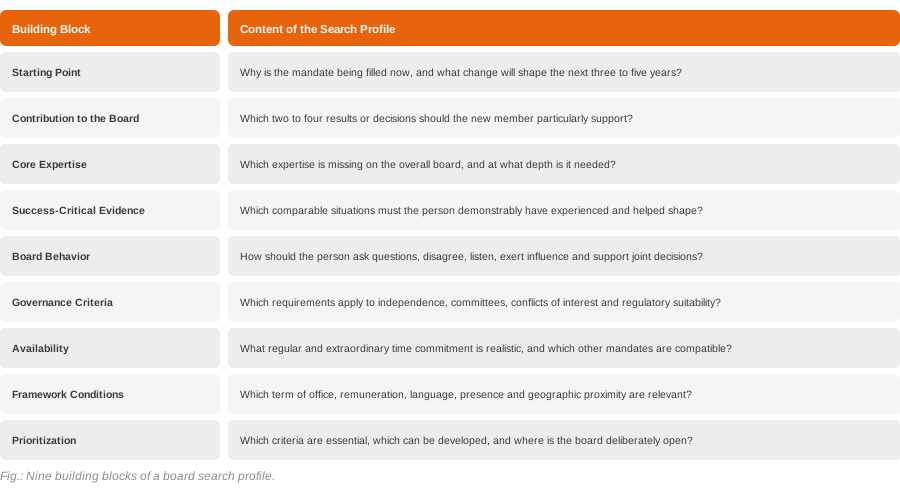
The profile should be approved before specific names are discussed. As soon as a well-known person is in the room, criteria are easily adjusted after the fact. A decision logic agreed in advance protects the quality and traceability of the process.
6. Combining Expertise, Personality and Independence
The professional gap alone does not yet determine who will be effective on the board. A robust profile combines three levels without mixing them.
— Expertise
The person brings relevant experience from situations that fit the next company phase. What matters is not the longest industry tenure, but the quality and transferability of the experience.
— Personal contribution
The profile describes observable behavior on the board: judgment, quality of questions, handling of uncertainty, ability to disagree and willingness to bear collective responsibility.
— Independence and integrity
Possible conflicts of interest, economic relationships, other mandates and personal dependencies must be examined transparently at an early stage. Formal eligibility does not replace the ability to form an independent judgment.
Diversity should also be made concrete as a contribution to decision quality. Different experiences, perspectives, genders, generations and backgrounds can reduce blind spots. The search profile should therefore name which perspective today's board lacks, rather than citing diversity only as a general goal.
7. Assessing Board Readiness
Not every suitable person already holds several board mandates. Too narrow a demand for long-standing board experience can unnecessarily restrict the candidate market and exclude new perspectives. Conversely, operational seniority alone is not enough.
Board readiness is shown by whether a person can move from operational responsibility to an overarching role. They must grasp complex matters quickly, judge with limited information, understand the responsibility of the body and exert influence without line authority. Structured interviews, references and a realistic board case study make this ability more observable than a comparison of titles.
8. Mirroring the Profile Against the Candidate Market
A search profile is first of all a hypothesis. Before a broad approach, it should be tested whether the desired combination of expertise, board experience, independence, language, availability and remuneration is realistic in the market. An early market check shows which criteria unnecessarily narrow access to suitable personalities.
— Limit must-have criteria
Too many non-negotiable requirements lead to a theoretically perfect but barely available profile. Three to five genuine must-haves are usually enough to steer the search.
— Allow transferable experience
A person from an adjacent industry or a different ownership environment can be more valuable than a nearly identical résumé. The profile should describe which experience must be transferable.
— Test the attractiveness of the mandate
Board candidates also assess the task, influence, reputation, governance, time commitment and collaboration. The mandate must be presented clearly and credibly.
— Define the search space deliberately Geography, language, regulation and presence requirements determine the market. These boundaries should follow from the task and not be adopted out of habit.
At the latest at this market check, a specialized board search advisor can add value. They examine how large the realistic candidate pool is, which requirements can sensibly be combined and where the board must prioritize. For this, Wirz & Partners combines functional board practice, industry knowledge and access to the Swiss candidate market. The decision on the profile remains with the board or the nomination committee.
9. Turning the Search Profile into a Fair Selection
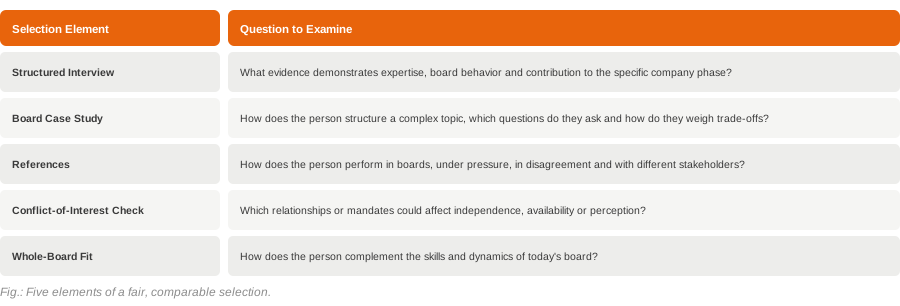
The search profile only fulfills its purpose when it steers the selection. All candidates should be assessed against the same core criteria. Personal familiarity, reputation or a convincing first conversation must not replace the agreed logic.
The W-SCIAF methodology of Wirz & Partners translates the search profile into a structured selection process. Context analysis and skills matrix define the criteria; structured interviews, reference checks and practical case studies test them from different perspectives. Candidates are thereby assessed by the same decision logic and prepared in a comparable way for the board.
10. When an External Board Search Makes Sense
External support is particularly valuable when the succession must be prepared confidentially, the profile sought lies outside existing networks, or several stakeholders have different expectations of the mandate. For new committee requirements, a strategic realignment or a tight candidate market, an independent perspective also helps sharpen the criteria before the search.
A board search partner does not take the election decision away from the board. It structures the need, opens up additional candidate pools, conducts the direct approach discreetly and creates a consistent basis for decision. Wirz & Partners accompanies this process from profile clarification through search and assessment to final selection and onboarding. What remains decisive is that the board approves the search criteria in advance and later justifies any deviations deliberately.
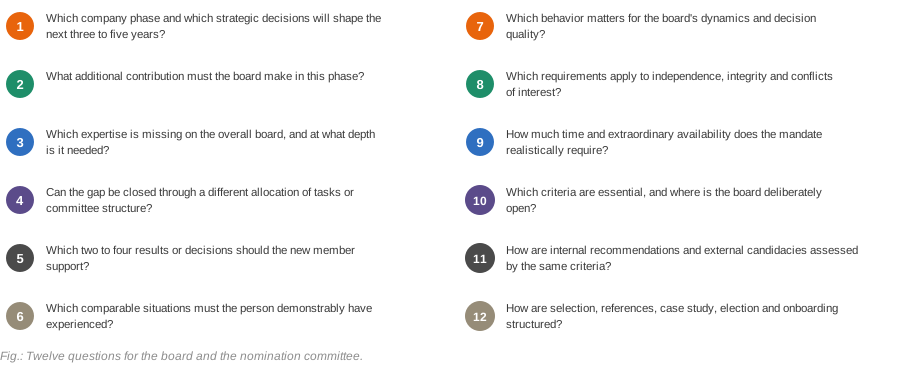
11. The Twelve Questions for the Board and the Nomination Committee
Conclusion
A robust board search profile does not begin with a name and not with the résumé of the departing member. It begins with the next company phase and the question of what additional contribution the board must make as a body.
From future state, skills matrix and board mandate emerges a prioritized profile with verifiable experience, a clear personal contribution and realistic governance criteria. This foundation improves the search and makes the later decision traceable. It helps the board not only to fill a vacancy, but to deliberately develop its own effectiveness.