


A CEO succession is not merely an HR decision. It is a decision about the company's direction. Anyone who simply extends the profile of the current incumbent is searching for the past. A resilient search profile therefore begins with the question of which company the successor should lead in the years ahead.
The sound sequence is: clarify the future state, derive the strategic and organizational requirements, define the CEO mandate, and only then describe experience, personality and leadership behavior in the search profile. This turns a wish list into a verifiable basis for decision-making.
1. Understanding CEO Succession as a Strategic Process
— Succession begins before the vacancy
The earlier the board and owners discuss the future state and possible scenarios, the greater the room to maneuver. Under time pressure, requirements are more easily carried over from the past or framed too broadly.
—Separate planned and unplanned succession
A planned transition allows for market benchmarking, internal development and a prepared handover. A sudden departure additionally requires a resilient contingency plan with interim responsibility and clear communication.
— Responsibility rests with the board
The board must secure the vision, mandate, selection process and decision logic. Analysis and process management can be delegated — responsibility for the company's most important leadership appointment cannot.
2. Defining the Future State of the Next Company Phase
The future state translates strategy into a concrete leadership context. It should reach far enough into the future to make structural change visible, while remaining concrete enough to derive requirements for the CEO role. For many companies, a horizon of three to five years is appropriate.
— Business and value creation
From which markets, customer groups, products and business models should value be created in the future? Which parts of today's portfolio are losing relevance?
— Growth and results
What scale, profitability, return on capital or market position should be achieved? Where are the key assumptions and risks?
— Organization and capabilities
What structures, leadership levels, technologies and competencies are needed? What must scale, be simplified or be built anew?
— Ownership and governance
How will the ownership role, board, capital structure and decision paths evolve? Which expectations need to be balanced?
— Culture and change
Which characteristics of today's culture secure success? Which behaviors would block the next phase and must be deliberately changed?
The result is not a miniature strategy paper.
It is a shared picture of the conditions under which the successor must have impact.
3. From Future State to CEO Mandate
The mandate answers what the successor should actually change, secure or build. It separates the entrepreneurial task from general expectations of a good leader.
— Name the starting position
Which results, capabilities and relationships are stable? Where are the strategic gaps, operational risks or unresolved conflicts?
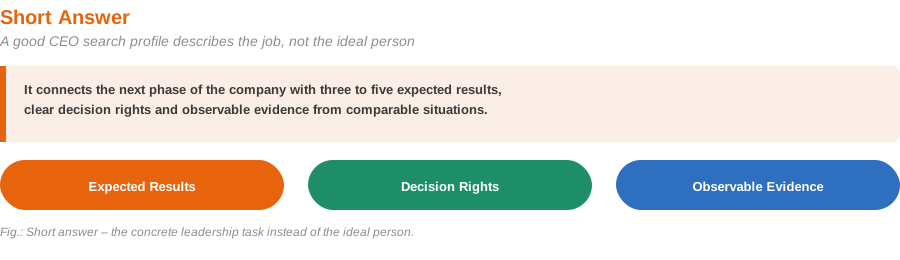
— Define three to five results
Formulate verifiable outcomes for 12, 24 and 36 months. Examples include a new growth platform, improved quality of results, an integrated organization or a resilient leadership team.
— Clarify decision rights
Which decisions belong to the CEO, which to the board or the owners? Unclear governance renders even a good profile ineffective.
— Weight continuity against change
What must the succession deliberately preserve, what should it further develop, and what must it let go of? This weighting shapes the search more than the title CEO.
4. Four Degrees of Change
Not every succession needs the same type of CEO. A deliberate classification of the degree of change is helpful.
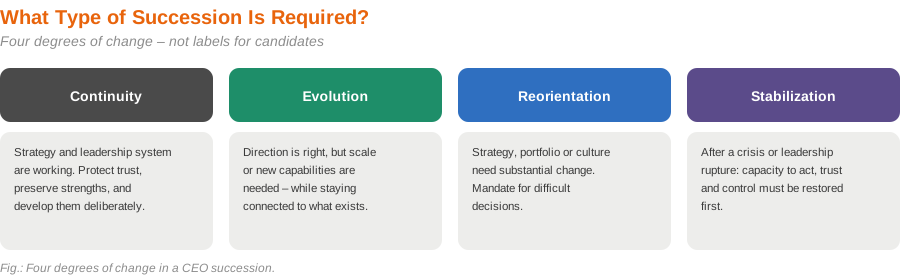
These categories are not labels for candidates. They help the board openly discuss the actual task and the necessary degree of change.
5. Orientation Matrix: From Future State to CEO Mandate
The following matrix serves as a basis for discussion. It replaces neither the diagnosis of the company context nor prioritization by the board
.svg)
6. Translating the Mandate into a Resilient Search Profile
Only once the mandate is clear are the requirements for the person defined. A resilient profile distinguishes between necessary evidence, developable capabilities and mere preferences.
— Formulate experience as evidence
Do not simply demand ten years of industry experience across the board. Describe the situations a person must have successfully mastered — for example international scaling, portfolio clean-up, or leadership through an ownership transformation.
— Make leadership observable
Terms like visionary, assertive or empathetic are too abstract. Define what behavior is expected in critical situations and how it is recognizable in the selection process.
— Make contextual fit concrete
Fit covers company maturity, governance, ownership logic, pace, culture and the existing leadership team. It must not be confused with personal similarity.
— Connect motivation and scope for action
A role is only attractive and realistic when responsibility, decision rights, compensation, location and time horizon align.
— Separate must-haves, nice-to-haves and openness
Too many must-have criteria narrow the market and create false precision. Limit the non-negotiable requirements and deliberately name where different career paths can lead to success.
7. The Executive Scorecard for CEO Selection
A compact scorecard connects the future state with the later selection decision. It should be agreed before the first candidate contact.
.svg)
The underlying logic follows Wirz & Partners' W-SCIAF methodology : the assessment emerges from the interplay of context, mandate, stakeholder dynamics and the candidate market. A skills matrix, structured interviews, references and practical case studies then make the requirements comparable and observable.
8. Comparing Internal and External Succession Fairly
Internal candidates know the business, culture and stakeholders. External candidates often bring new patterns, different networks and greater distance from the status quo. The decision should not follow a fundamental preference, but the same future-state mandate.
— Apply consistent criteria
Internal and external candidates are assessed against the same results, evidence areas and leadership requirements. Familiarity must become neither a bonus nor a penalty.
— Separate potential from experience
An internal candidate can have development potential without having already experienced every required situation. What matters is which gaps can realistically be closed in the available time, or compensated for within the team.
— Secure confidentiality and fairness
fairness
Internal options require clear expectations, a professional process and respectful handling of possible non-decisions. Otherwise, the succession risks the retention of key leaders.
— Use the market as a calibration point
Even with a strong internal option, a structured market benchmark helps realistically assess expectation levels, availability and alternatives.
9. Setting Governance, Timeline and Handover
The process needs clear roles before names are discussed. This includes the decision-making body, project leadership, involvement of the incumbent CEO, information channels, confidentiality and handling of conflicts of interest.
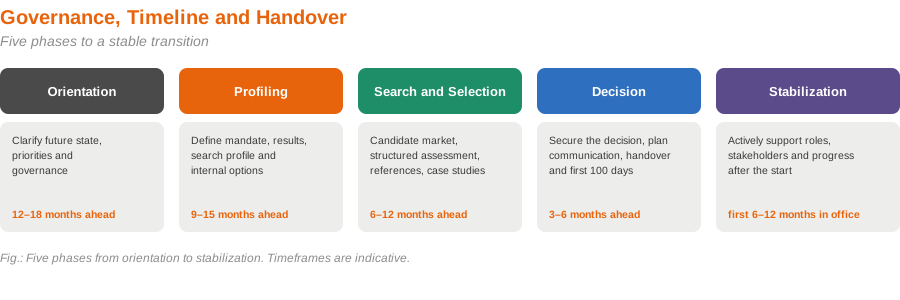
Timeframes are indicative. Company situation, notice periods, internal development and the availability of suitable people can significantly shorten or extend the process. An emergency succession plan should be in place at all times, regardless.
10. The Most Common Mistakes in CEO Succession
— Copying the predecessor's profile
This implies continuity even though strategy, organization or owner expectations may have changed.
— The future state remains vague
General terms like growth or transformation do not produce a clear selection decision. Priorities, results and trade-offs are missing.
— Too many stakeholders shape the profile
Unmoderated individual wishes lead to a contradictory ideal profile. The board must weigh requirements and decide on trade-offs.
— Charisma replaces evidence
A compelling presentation says little about whether a person will have impact in the specific context. Structured interviews, references and cases test resilient experience.
— The handover is planned too late
The process does not end with the selection. The departing CEO's role, communication, stakeholder handover and the first months in office must be prepared early.
Conclusion
A resilient CEO succession does not begin with a list of attributes, nor with the question of who is available. It begins with a shared picture of the company's next phase. From this emerges a mandate that weighs continuity against change, names results and anchors the role within the governance system.
Only then is it determined what experience, leadership behavior and contextual fit a person must bring. This sequence does not just improve the search profile. It creates a traceable decision logic for the board, owners and executive team — and a sound basis for selection and handover.