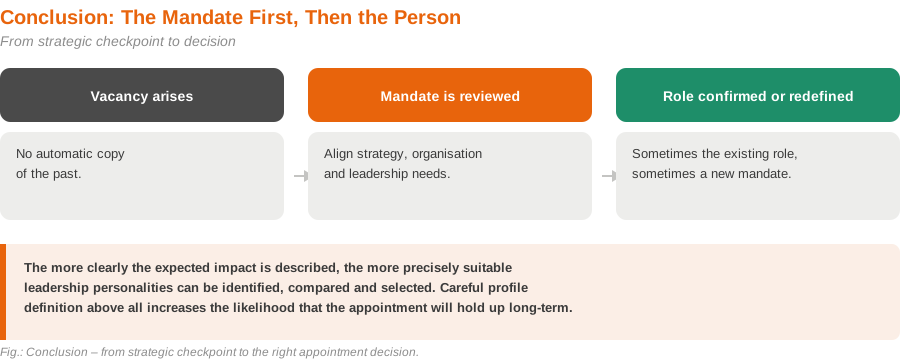

When a leader leaves the company, the seemingly simplest solution presents itself: update the existing job profile and start the search. But a vacancy at the executive or divisional leadership level is more than a personnel gap. It is a strategic moment to examine what kind of leadership the company actually needs for its next phase.
The decisive question is therefore not: Who can replace the previous person? But rather: What mandate must the role fulfil going forward — and what kind of personality can be effective in it?
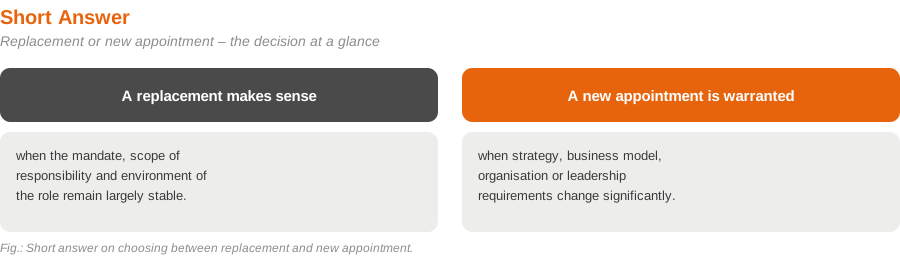
A classic replacement makes sense when the mandate, scope of responsibility and environment of the role remain largely stable. A new appointment with a redefined mandate is warranted when strategy, business model, organisation or leadership requirements change significantly.
1. Treating the Vacancy as a Strategic Checkpoint
— Don't simply extend the pastAn existing job profile often describes what the previous role holder did. It does not automatically say what the company will need going forward. Anyone who adopts the old profile unchanged may be searching very precisely for the wrong solution.
— Shift from the person to the task
Especially with long-serving executives, role and person tend to blend together: responsibilities were informally expanded, relationships became personal, decisions were made outside the org chart. Before a search begins, these elements must be separated.
— Orient the time horizon forward
A robust search profile isn't based solely on the current situation. It translates the company's goals for the next 24 to 36 months into a clear leadership mandate.
.svg)
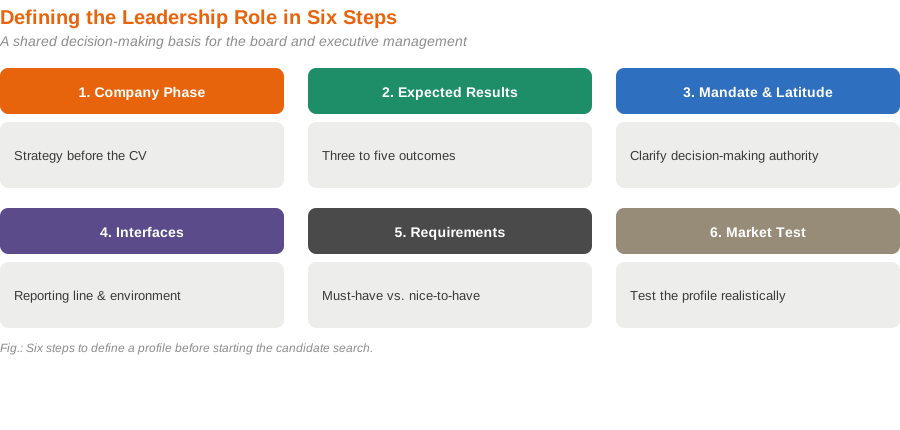
2. When a Classic Replacement Makes Sense
— The mandate remains fundamentally stable
Strategy, business model and organisational embedding do not change materially. The role continues to serve the same purpose with comparable decision-making authority.
— The previous role architecture worked
Interfaces, responsibilities and governance were clear. The vacancy arose primarily from a personnel change — not from structural problems or new requirements.
— Success can be clearly defined
There is agreement on what results the role must deliver. In this case, the existing profile can serve as a starting point — though it should still be critically reviewed and updated.
3. When the Role Should Be Redefined
— The company's phase is changing
Growth, internationalisation, transformation, restructuring, succession or post-acquisition integration often call for a different leadership profile than the previous phase.
— The business model is shifting
Digitalisation, new regulatory requirements, changing customer needs or new revenue models can require competencies barely present in the previous profile.
— The previous division of roles created friction
Unclear responsibilities, duplication or recurring conflicts indicate that not just the person, but the mandate itself needs to be reviewed.
— The leadership team needs a new addition
Not every role must cover every competency itself. What matters is which capabilities already exist across the leadership team as a whole — and which should be deliberately added through the new appointment.
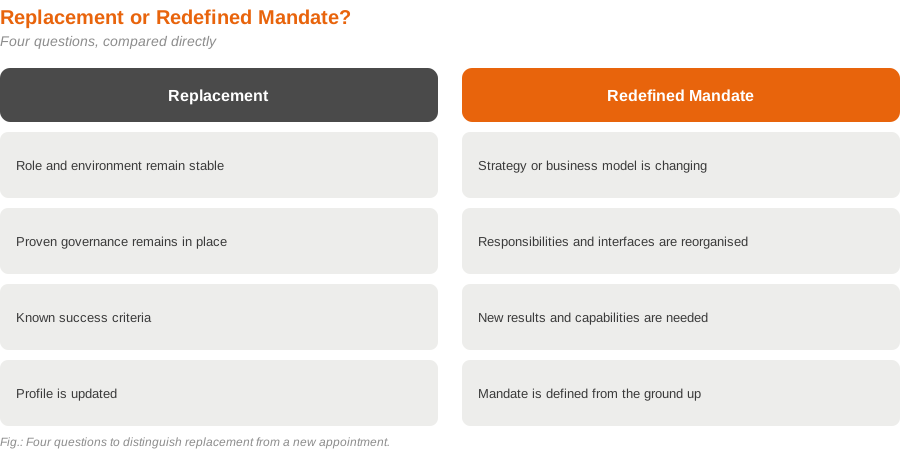
4. Defining the Leadership Role in Six Steps
Profile definition should be completed before the candidate search begins. The following six steps create a shared decision-making basis for the board, executive management and other relevant stakeholders.
— 1. Describe the company's next phase
Start with strategy, not the CV. What changes lie ahead in the next two to three years? Where should the company grow, stabilise, professionalise or transform? What risks need to be managed?
— 2. Define three to five expected results
Define concretely what success will look like. Instead of a long task list, a few prioritised outcomes are needed — for example, scaling a business unit, building a new organisation, improving results, or developing the next leadership tier.
— 3. Clarify the mandate and decision-making latitude
Which decisions does the role make itself? Where is sign-off needed from the CEO, board or group? What resources are available? A demanding task without sufficient room to act is not an attractive mandate.
— 4. Understand interfaces and leadership context
A leader's effectiveness depends significantly on their environment. Reporting line, team size, relevant stakeholders, collaboration within the executive team, and potential areas of tension all need to be clarified.
— 5. Rigorously prioritise requirements
Separate must-have criteria from developable skills and mere nice-to-haves. Not every successful leader needs to have already held exactly the same role in the same industry. What matters is which experiences are genuinely critical to success in this specific task.
— 6. Test the profile against the market
Before the search starts, check whether the profile is realistic and attractive. Are there enough suitable leadership candidates? Do the mandate, location, compensation and employer positioning match the expectations of the relevant market?
Rule of thumb: The longer the requirements list, the more important prioritisation becomes. A profile with fifteen must-have criteria rarely creates certainty — it usually narrows the market and obscures what really matters.
5. From Job Description to Executive Scorecard
A classic job description documents tasks and responsibilities. For a leadership appointment, that is not enough. An Executive Scorecard translates the mandate into observable, comparable criteria:
- Purpose of the role: Why does the function exist, and what contribution does it make to strategy?
- Expected results: Which three to five outcomes should be achieved, and in what timeframe?
- Required competencies: What functional, strategic and leadership-related capabilities are needed?
- Leadership and culture: What leadership style fits the task, the team and the company culture?
- Evidence in the selection process: How can it be recognised — in the CV, the interview, and through references — that a candidate meets these requirements?
.svg)
These criteria should then guide the entire selection process — from research through interviews to reference checks. This way, decisions are made not on sympathy or resemblance to the predecessor, but on the expected impact in the role.
6. The Most Common Mistakes in Profile Definition
— The existing profile is only updated linguistically
New wording is no substitute for a strategic reassessment. The starting point must be the company's future goals.
— The predecessor becomes the ideal profile
Anyone who copies the strengths, working style and career path of the previous leader may overlook that the next phase requires different qualities.
— Every stakeholder gets a veto
Too many unresolved expectations lead to a contradictory profile. Stakeholders should be heard; responsibility for prioritisation and decision-making must nonetheless remain clear.
— Experience is mistaken for impact
Years in the industry, titles and company size are easy to measure. However, they do not automatically prove that a person has delivered the required results under comparable conditions.
— Culture fit remains a vague phrase
Terms like entrepreneurial, hands-on or team-oriented are too imprecise. More helpful are concrete behaviours and situations in which the desired leadership style becomes visible.
The Ten Most Important Questions Before Starting the Search
- Which company phase should this leader successfully shape?
- Which three to five results must they achieve in the first 24 to 36 months?
- What should deliberately change compared to the previous appointment?
- Which responsibilities belong to the role — and which explicitly do not?
- How much genuine decision-making and shaping latitude is there?
- Which capabilities are currently missing from the leadership team?
- Which requirements are non-negotiable, and which are developable?
- Which cultural and leadership-related behaviours are critical to success?
- Which candidate markets are worth considering beyond the obvious industry?
- How will each requirement be concretely verified in the selection process?
Conclusion: The Mandate First, Then the Person