


When a company needs to grow, improve profitability or fundamentally transform, the same question often arises: which leadership role do we need to fill?
The obvious answer is frequently a title—CFO, COO, CSO, CIO or a new transformation role. But a title alone does not remove a constraint.
A robust sequence is to clarify the objective, identify the primary constraint, define the mandate and only then determine the appropriate type of role. Depending on the starting point, the same growth ambition may require a sales leader, an operations executive, a CFO or a CEO with a revised mandate.
.svg)
1. Start with the business constraint, not the title
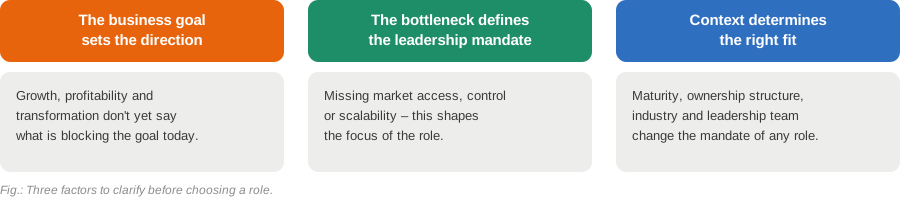
Bevor eine Position definiert wird, lohnt sich der Blick auf drei Fragen: Welches Ziel wird verfolgt, was genau verhindert es heute – und welcher Kontext prägt die Rolle, die daraus entsteht?
— The business objective sets the direction
Growth, profitability and transformation are strategic objectives. They do not yet reveal what is preventing the company from achieving them today.
— The constraint determines the leadership mandate
If market access is lacking, the lever is more likely to lie in commercial leadership. If performance management and financial transparency are missing, Finance moves to the centre. If processes do not scale, operational accountability is required.
— Context determines fit
The company’s maturity, ownership structure, industry, culture and existing leadership team all shape the role. A CFO in a private-equity environment needs a different mandate from a CFO in a family-owned industrial company.
2. Which role enables growth
Growth can be constrained at very different points. Before creating a new position, determine whether the primary constraint lies in the market, the offering, delivery capability, financing or the organisation.
— CSO, CRO or Sales Director
Appropriate when market potential exists but the sales model, pipeline, key-account development or leadership of the sales organisation is not delivering the required impact. A CRO is particularly plausible when Marketing, Sales and Customer Success need to operate under one revenue model.
— CMO or Commercial Lead
Relevant when positioning, brand strength, customer insight or demand generation limits sales. The mandate must be measurably linked to market and business impact—not merely to communications.
— COO
Required when demand exists but processes, delivery, quality or the supply chain do not scale. The COO makes growth operationally manageable.
— CFO
A growth-oriented CFO creates financial transparency, scenarios, financing capacity and disciplined capital allocation. The role is particularly relevant for international expansion, acquisitions, IPO preparation and PE- or VC-backed business models.
— CTO, CIO or Product Lead
This role is appropriate when technology architecture, product development, data or business IT constrain scaling. It is essential to distinguish product technology, internal IT and accountability for the digital business model.
— CEO or Managing Director
When several growth levers need to be realigned at the same time, the company often needs a sharper overall mandate at the top rather than another specialist function.
3. Which role improves profitability
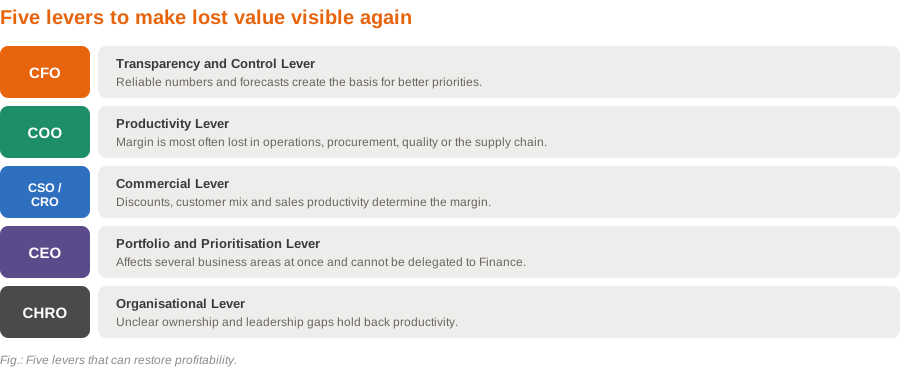
Profitability rarely results from a single cost initiative. It reflects pricing, mix, productivity, utilisation, working capital and clear accountability for results. The first step is therefore to determine where value is being lost.
4. Which role leads transformation
Transformation is not a single, uniform undertaking. Digital renewal requires different leadership from restructuring, post-merger integration or cultural change.
— CEO or Managing Director
The top executive must lead transformation when strategy, the business model and the distribution of authority are affected. A transformation function can coordinate, but it cannot replace overall accountability.
— CIO or CDO
A CIO connects technology, processes and business objectives when internal IT and digital enablement are central. A CDO makes sense when new digital products, channels or business models need to be built across functions.
— CTO
The CTO owns the technology product vision and engineering capability—particularly in technology-led companies. The role should not be conflated with traditional corporate IT.
— CHRO or Chief People Officer
When new capabilities, leadership behaviour, organisation and culture determine success or failure, the People function needs strategic influence and clear shared accountability for implementation.
— Chief Transformation Officer
A temporary transformation leader can be effective when a clearly defined, cross-functional programme must be delivered at pace. The mandate, duration and handover to the line organisation should be established from the outset.
5.Orientation matrix: from constraint to role
The following matrix is an initial hypothesis, not an automatic allocation. It helps the board and executive management shift the discussion from a preferred title to the constraint that needs to be resolved.
.svg)
6. Six steps to the right leadership mandate
A sound role decision emerges from a structured clarification process. In practice, the following sequence has proven effective:
— 1. Define the priority outcome
What specific change must be achieved over the next 24 to 36 months? Formulate an outcome, not merely a direction.
— 2. Validate the constraint with evidence
Where is the company currently losing revenue, margin, speed or future viability? Use metrics, customer feedback, process data and the perspectives of relevant stakeholders.
— 3. Assess existing leadership capacity
Which responsibilities already sit with the CEO, CFO, COO or other members of executive management? Is the gap one of capability, capacity, authority—or simply clear governance?
— 4. Define the mandate before the title
Describe the expected outcomes, decision scope, resources, reporting line and critical interfaces. Only then decide which title will be understood in the market.
— 5. Compare alternatives deliberately
Assess at least three options: broaden an existing role, redistribute responsibilities within the leadership team or create a new role. Consider impact, speed and added complexity.
— 6. Test the profile and mandate against the market
Assess whether suitable executives are available and whether accountability, remuneration, location and scope to shape the role are aligned. An unrealistic profile should be corrected before the search begins.
.svg)
7. Clarify role boundaries and combined mandates
— CFO and COO
Both can drive profitability. The CFO creates transparency, performance management and capital discipline; the COO owns operational execution. If the mandates are combined, priorities and operational proximity must remain realistic.
— CSO, CMO and CRO
The CSO primarily leads Sales, the CMO owns market and demand, and the CRO leads the integrated revenue engine. What matters is not the most fashionable title, but clear logic for outcomes and interfaces.
— CIO, CDO and CTO
The CIO leads business IT and digital enablement, the CDO digital transformation or new business models, and the CTO product and technology architecture. In smaller organisations, mandates can be combined—but they must not become ambiguous.
— CEO and Transformation Lead
A transformation needs a visible sponsor at the top. A programme leader can create pace and coordination, but requires a clear mandate from the CEO and the board.
8. Translate the role into verifiable selection criteria
Once the role has been clarified, it should be translated into a concise Executive Scorecard. This keeps the logic consistent from the business objective through to the selection decision.
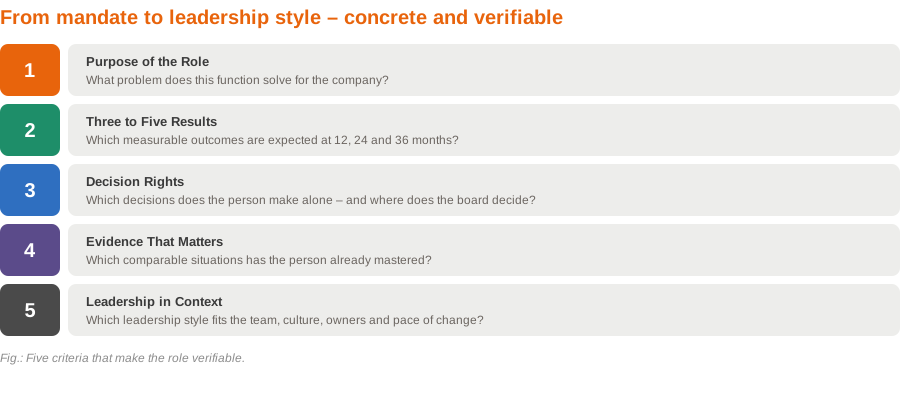
This approach reflects a core principle of Wirz & Partners’ W-SCIAF methodology: fit is not established through an isolated CV comparison, but through an understanding of the role, organisation, stakeholder dynamics and candidate market. A skills matrix, structured interviews, references and realistic case studies then make the requirements comparable and observable.
9. The most common mistakes when selecting a role
— A prominent title replaces proper diagnosis
A new C-level title creates visibility, but without a clear constraint and mandate it often creates additional interface problems.
— One person is expected to solve every problem
Combining growth, efficiency, digitalisation and cultural change in a single profile creates unrealistic requirements and an unnecessarily narrow candidate market.
— Accountability and authority do not match
Anyone accountable for an outcome needs access to the relevant resources, data and decisions. Otherwise, the role remains symbolic.
— The existing leadership team is overlooked
The new role must complement missing capabilities—not duplicate strengths already present or intensify unresolved conflicts.
— Cultural fit is confused with similarity
The aim is not to find the person most similar to the current team, but an executive who can be effective in this environment and help shape the next phase.
Conclusion
The question of the right leadership role cannot be answered with a generic ranking. Growth may require stronger sales leadership—or a COO who can scale delivery. Profitability may require a CFO as a performance partner—or an operational realignment. Transformation may be a technology, people or overall leadership challenge.
.svg)