


An executive team can be staffed with strong individuals and still no longer fit the company's task. This often happens when strategy, business model or owner expectations change faster than roles, decision paths and collaboration within the leadership team. The result is duplication, gaps and slow decisions. Organizations then often search for a new person, when the architecture of the executive team should be clarified first.
An ExCo transformation therefore does not begin with the org chart, nor with individual names. It begins with a clear picture of the next company phase. From this, you can derive which results the executive team must jointly own, which capabilities the team needs, and how responsibility should be distributed.
1. How to Recognize That Today's ExCo No Longer Fits
The need for action rarely shows up as a single event. Usually several signals accumulate. What matters is distinguishing a performance problem of individuals from a structural problem of the leadership system.
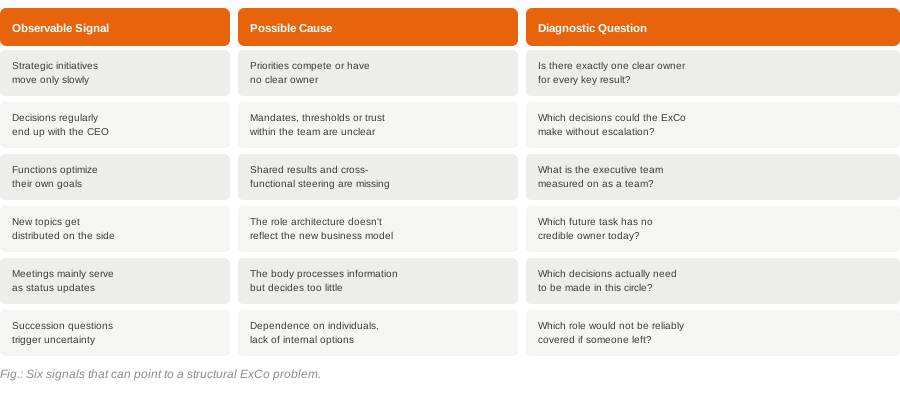
A single signal does not yet justify a reorganization. If several symptoms persist over time, or a strategic turning point is approaching, the board should deliberately review the leadership system together with the CEO.
2. Not Every Weakness Calls for New People
ExCo transformation is quickly equated with replacing people. That falls short. Depending on the cause, clearer prioritization, a changed governance model, or developing existing members can achieve more than an external hire. Before personnel decisions are made, it should be clarified at which level the gap actually lies.
— Strategic clarity
The executive team can only be effectively staffed once the next company phase is concretely described. General goals such as growth, digitalization or efficiency are not enough. What's needed are prioritized results, trade-offs and a realistic time horizon.
— Mandates and interfaces
Capable people are often in roles whose scope of responsibility no longer matches reality. Unclear handoffs between Commercial, Operations, Finance, Technology and People create friction that is mistakenly read as a personal problem.
— Capability and capacity
A member may be fundamentally suited but lack either the necessary experience or enough time for a new task. Development, additional resources or a redistribution of responsibility can close the gap.
— Collaboration and behavior
When information is withheld, conflict is avoided, or decisions are second-guessed afterward, the problem lies in shared leadership behavior. A new org chart does not automatically change this pattern.
— Personal fit
A change is warranted when the future mandate demonstrably requires different capabilities or different leadership behavior, and the gap cannot realistically be closed within the required timeframe.
3. Four Interventions in the ExCo
Diagnosis does not automatically lead to a complete overhaul. In practice, four depths of intervention can be distinguished. They can build on one another, but should not be mixed before the target picture is settled.
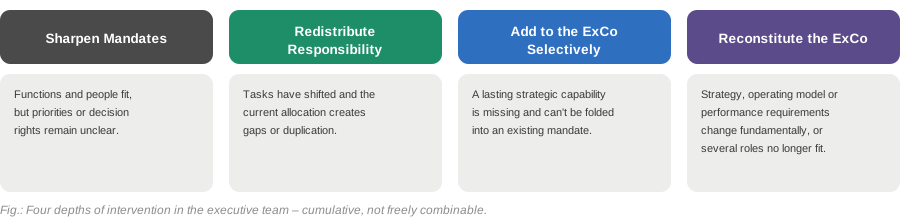
The smallest intervention depth is not automatically the best one. It makes sense when it actually closes the strategic gap. Conversely, a comprehensive overhaul should not arise from a desire for a visible fresh start, but from a traceable diagnosis.
4. Designing the Executive Team's Target Picture
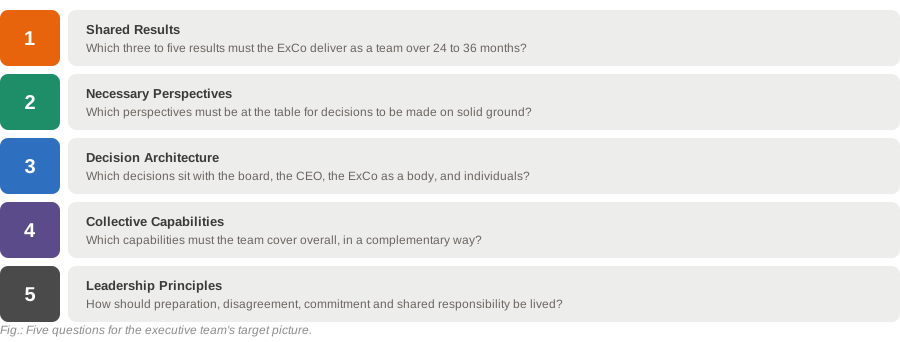
The target picture does not start with titles and reporting lines. It shows what work the leadership team must jointly deliver in the next phase. A good draft answers five questions.
.
5. Three Typical Transformation Situations
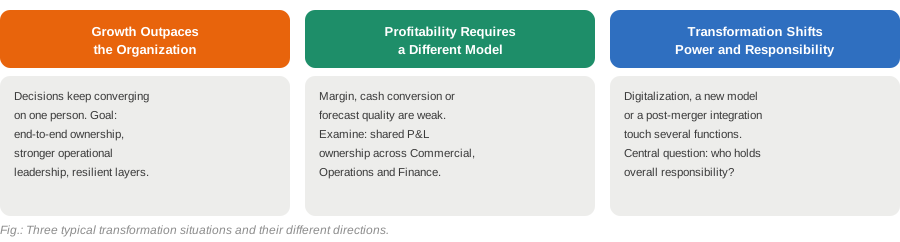
The right ExCo structure depends on the specific company phase. The following situations show how differently the same wish for a stronger executive team can play out.
6. Assessing the Existing Leadership Team
Once the target picture is set, today's ExCo is measured against it. This assessment should become neither a collection of subjective impressions nor a covert selection process. It needs transparent criteria and a clean way of handling uncertainty.
— Team before individual
First it is examined whether the needed capabilities, perspectives and roles are covered across the whole team. Only then is it assessed which person can contribute what. This avoids building the target picture around existing résumés.
— Evidence, not adjectives
Terms like strategic, agile or entrepreneurial are too open. What matters are observable situations: what comparable change has the person led, what decisions did they make, and what results were achieved?
— Separate performance from potential
Current performance shows how someone operates within the existing mandate. Potential describes whether the person can take on a significantly changed mandate. Both questions need different evidence and must not be conflated.
— Check contextual fit
A leader can succeed in a strongly centralized environment and lose effectiveness in a decentralized model. Fit covers governance, maturity, culture, ownership logic and how the person works with the rest of the team.
— Make risks explicit
Every option has development areas. What matters is which gaps are tolerable, how they can be offset, and which risks are not acceptable for the next company phase.
This reasoning follows Wirz & Partners' Context Mastery and W-SCIAF methodology: fit does not arise from an isolated profile match. Role, organization, stakeholder dynamics and the candidate market must be considered together. A skills matrix, structured interviews, references and practical case studies then create a shared basis for decision-making
7. Reordering Roles, Boundaries and Decision Paths
A new composition only has impact if the mandates fit together. A short mandate framework should therefore be captured for each ExCo role.
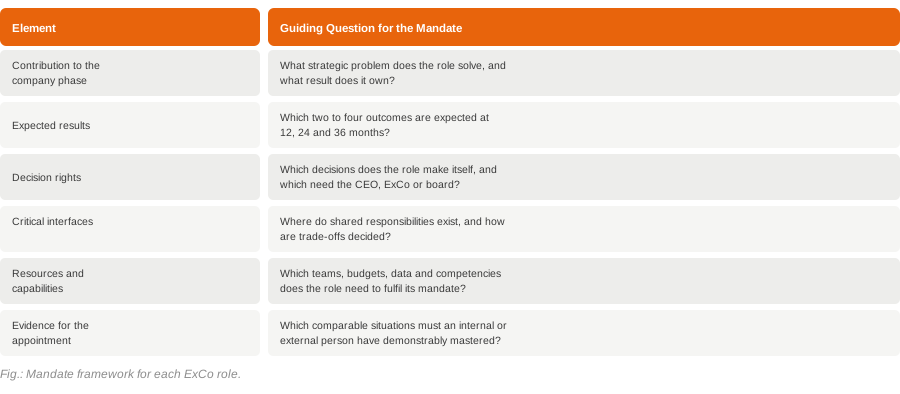
Interfaces between CFO and COO, Commercial and Product, CIO and CTO, and CEO and transformation leadership deserve particular care. Shared responsibility can be sound when it reflects a genuine joint decision. It becomes problematic when no one holds final accountability.
8. Who Leads the Process
Responsibility for an ExCo transformation remains with the Board of Directors and the CEO. The Board determines the CEO’s mandate and the governance framework, while the CEO is accountable for the effectiveness of the Executive Committee. When roles are redesigned, existing members assessed and external options considered, it is advisable to involve a specialised executive search adviser at an early stage.
An experienced executive search consultant provides an independent perspective and keeps three decisions distinct: What kind of ExCo does the company need? Which roles follow from this? And who can perform these roles effectively? The adviser translates the target operating model into assessable role profiles, evaluates internal and external candidates against the same criteria, and tests the requirements against the candidate market. This improves comparability and supports a confidential, objective process when sensitive issues arise.
A partner specialising in Board and C-level mandates, such as Wirz & Partners, can fulfil this role. The W-SCIAF methodology combines context analysis, a skills matrix, interviews, references and case studies to create a transparent and well-founded basis for decision-making.
9. From Org Chart to Implementation
Implementation proper begins once the target structure is decided. A coherent rollout connects personnel decisions, ways of working and communication. The sequence must be adapted to the situation and confidentiality requirements; the following timeline serves as orientation.
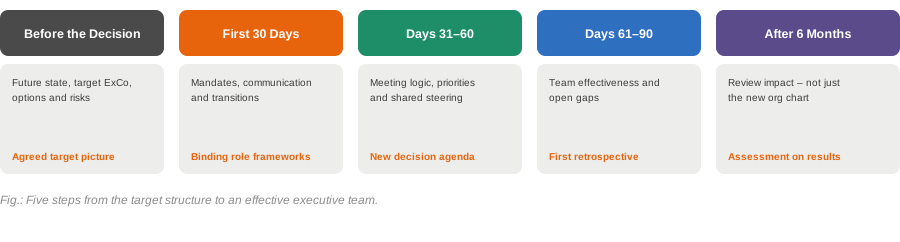
Communication should explain which company goal the change supports, which responsibilities are changing, and what stays stable. Personal reasons or confidential assessments do not belong in broad communication. What matters is that employees know who will decide going forward and how the new structure affects their collaboration.
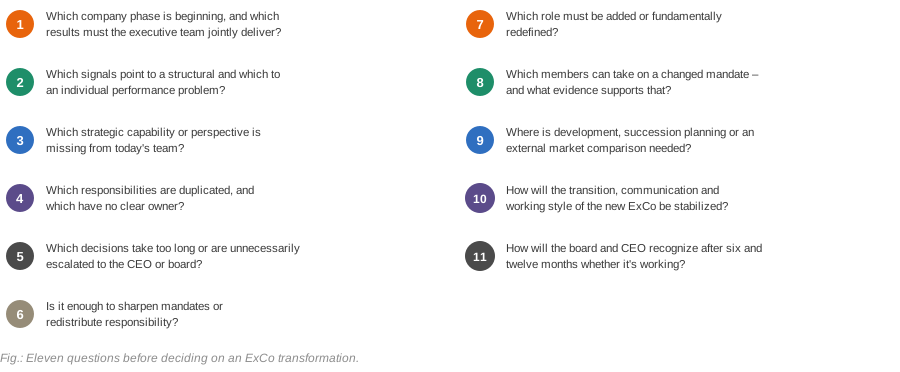
10. Questions Before the Decision
Conclusion
An ExCo transformation succeeds when the executive team can lead the next company phase better. This shows up not in new titles, but in clearer responsibility, faster and better decisions, and a team that jointly carries the prioritized results.
The sound logic is: first clarify the strategic task and the executive team's target picture, then determine the necessary depth of intervention, and only then decide on roles and people. This makes the reorganization traceable, fair and sustainable. At the same time, it creates a resilient foundation for development, succession planning and targeted external hires.